The Silence We Keep
There is a particular kind of loneliness that happens in a crowd. You can be surrounded by three hundred people in a Sunday service, sing every word of every song, and still walk out of the building carrying a weight no one saw. In a city like Jakarta—where traffic steals hours, work never seems to end, and everyone is performing "I'm fine" for survival's sake—mental struggle rarely announces itself. It hides behind a smile, a full calendar, a spiritual-sounding excuse for missing church again.
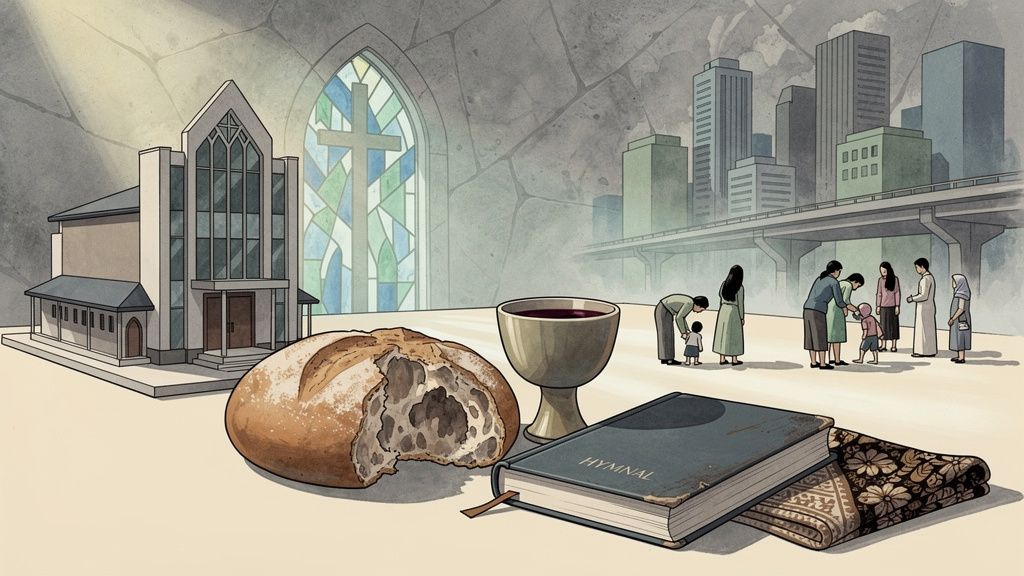
We need to say this plainly: depression, anxiety disorders, burnout, and other mental health struggles are not a failure of faith. They are part of what it means to live as embodied, finite creatures in a broken world east of Eden. Elijah—a prophet who had just seen fire fall from heaven—collapsed under a tree and asked God to let him die (1 Kings 19:4). Scripture does not scold him for weakness. God sends an angel to feed him, lets him sleep, and only then speaks. Before there was a word of correction, there was bread, rest, and presence.
That order matters enormously for how a church should respond to its struggling members.
Job's Friends: A Warning We Must Not Ignore
Job's three friends actually began well. When they heard of his suffering, "they sat with him on the ground seven days and seven nights, and no one spoke a word to him, for they saw that his suffering was very great" (Job 2:13). If the book of Job ended there, they would be remembered as models of compassion.
But then they opened their mouths. They diagnosed Job's pain theologically, insisted there must be hidden sin, and offered explanations where he needed presence. God's verdict on their speeches is scathing (Job 42:7).
This is the danger many well-meaning churches fall into today. A member confesses they've been struggling with depression, and the immediate response is a verse, a rebuke about "not having enough faith," or a suggestion to "just pray more." These responses, however sincerely meant, often communicate the opposite of the gospel: that love is conditional on quick recovery, and struggle is shameful.
The gospel says something different. Jesus himself, in the garden of Gethsemane, was "deeply distressed and troubled" and said, "My soul is very sorrowful, even to death" (Mark 14:33-34). If the sinless Son of God experienced overwhelming sorrow, we cannot treat emotional anguish as inherently sinful or as evidence of weak faith. Christ does not stand over strugglers demanding they pull themselves together. He entered our darkness so he could walk us through it.
What Walking Together Actually Looks Like
Real pastoral care rarely looks dramatic. It looks like:
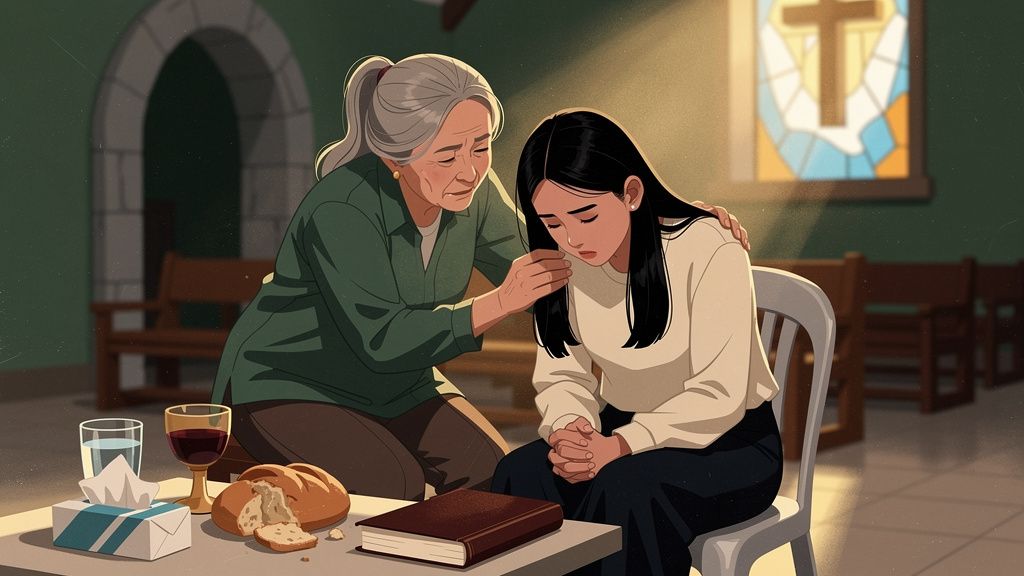
Presence before advice. Sitting with someone in their pain, as Job's friends first did, before rushing to fix or explain it. Sometimes the most Christlike thing a small group leader or friend can do is simply stay.
Believing them. Many people in our congregations have never told anyone about their struggle because they fear being seen as spiritually deficient. When someone finally speaks, our first response should be gratitude for their trust, not suspicion of their faith.
Practical partnership, not just prayer. Prayer matters deeply—but so does encouraging someone to see a doctor or counselor, helping a struggling single mother with childcare, or simply checking in on a Tuesday, not just a Sunday. Faith and medicine, prayer and professional help, are not competitors. Both are gifts from the same God who made bodies and minds.
Patience without a deadline. Recovery is rarely linear. Grace-shaped community doesn't demand a testimony of victory on a fixed timeline; it keeps showing up in month six, month twelve, even when there's no visible progress to celebrate.
The Church as a Hospital, Not a Stage
Timothy Keller often observed that many churches unintentionally function like theaters, where people perform wellness for an audience, rather than hospitals, where wounded people come honestly for healing. If our gatherings—including our weekly worship service—become places where only the strong and put-together are welcome, we have quietly abandoned the gospel we preach.
The gospel's scandal is precisely this: God's grace does not wait for us to be well. Christ died for us "while we were still sinners" (Romans 5:8)—not after we cleaned ourselves up, not after our mental health improved, not after our anxiety subsided. If grace can reach us in our sin, it can certainly reach us in our sorrow.
This is why a healthy church culture treats mental health struggles not as embarrassing secrets to be hidden but as part of the ordinary, honest life of a community still awaiting full redemption. Galatians 6:2 doesn't say "bear your own burdens quietly." It says, "Bear one another's burdens, and so fulfill the law of Christ."
An Invitation, Not a Diagnosis
If you are reading this while struggling silently, please hear this: you do not need to have your emotions sorted out before you are welcome among God's people. You do not need a testimony of triumph to walk through the doors of a church.
At GKBJ Taman Kencana, a Baptist church in West Jakarta serving since 1987, we hold services at 07:30, 09:30, and 11:30 every Sunday—not as performances for the polished, but as gatherings for people who, like Elijah under the tree, sometimes just need bread, rest, and someone willing to sit beside them. If you'd like to know more about our community or how to connect with a small group, you can read more about us or simply reach out through our Contact Us page.
Christ has not left us alone in our weariness. And neither should his people.